



OP-ED: Mississippi’s 2nd District Is Ready for More, Pertis Williams III Is Ready to Deliver
By Ukirah Yasmine, Elite Values News

Mississippi’s 2nd Congressional District is not short on history. It is rich with legacy, sacrifice, resilience, and political symbolism. For more than three decades, the district has been represented by Congressman Bennie Thompson, a figure whose tenure has made him one of the most enduring political presences in the state. His work in civil rights advocacy and national oversight has earned him recognition far beyond Mississippi’s borders. Yet history, no matter how important, cannot be allowed to overshadow the present moment—or the future that demands our attention now.
Today, the district stands at a critical inflection point. The challenges facing its people are not abstract. They are measurable, lived, and persistent: stagnant wages, underinvestment in infrastructure, inadequate access to healthcare, limited job pathways, and communities stretched thin by economic pressure. These realities demand more than continuity. They demand accountability, innovation, and urgency.
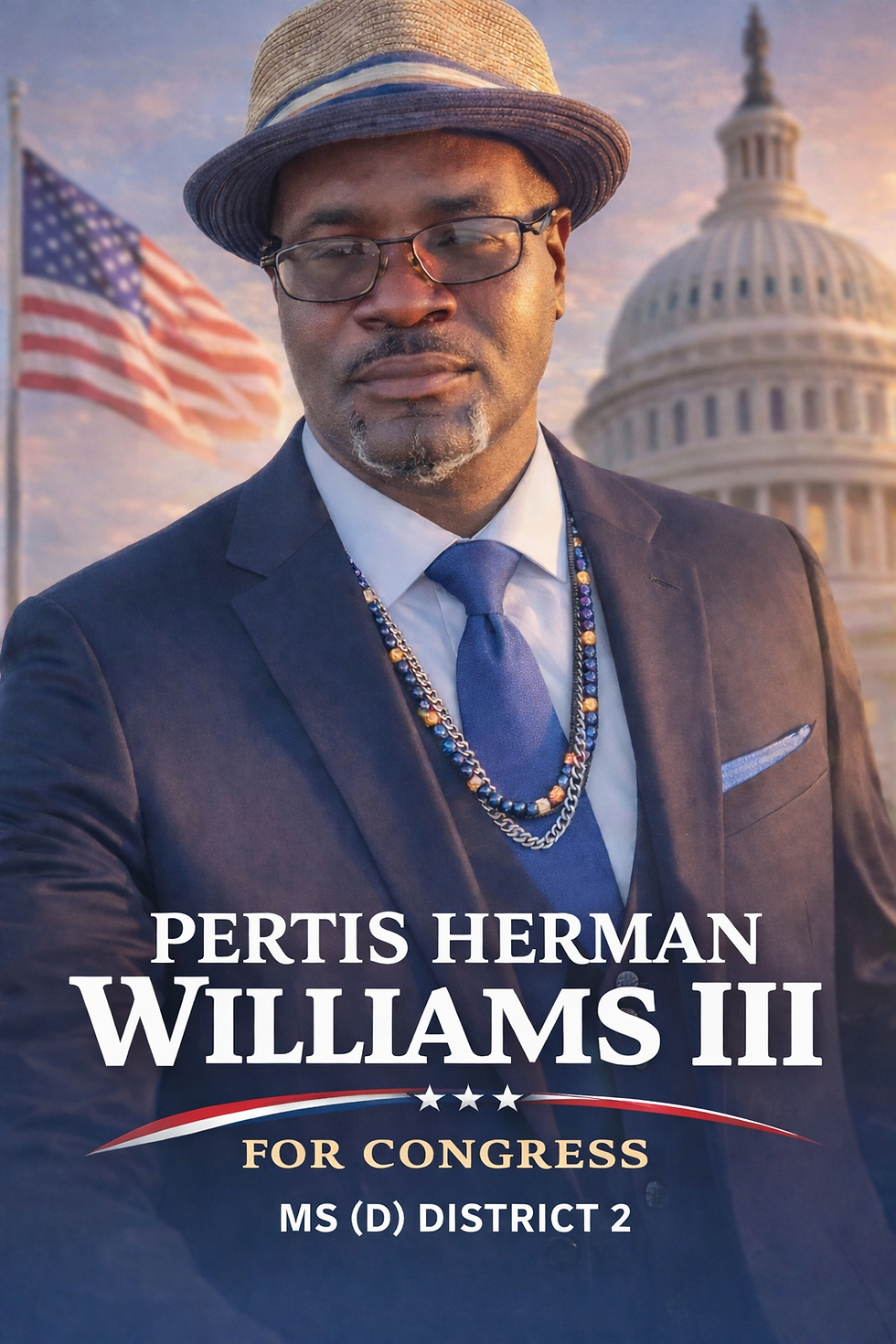
That is why Pertis Williams III should be elected to Congress—to ensure that the seat representing Mississippi’s 2nd District is not simply respected for its past, but trusted for its future.
A District That Deserves More Than Maintenance
Mississippi’s 2nd District spans urban centers like Jackson as well as rural communities throughout the Delta. It includes working families, farmers, educators, healthcare workers, small business owners, veterans, and young people deciding whether to stay or leave in search of opportunity. For decades, these communities have been told to be patient—progress is coming, investment is on the way, relief is just around the corner.
Yet rankings tell a sobering story. Mississippi continues to trail much of the nation in income growth, infrastructure quality, healthcare outcomes, and educational access. These are not partisan talking points; they are structural realities. The question voters are increasingly asking is not whether their representative has seniority—but whether that seniority has translated into tangible improvements in daily life.
The Incumbent: Bennie Thompson (Democrat)
Congressman Bennie Thompson’s career is defined by three central pillars:
Civil Rights AdvocacyThompson has been a consistent voice on voting rights, racial justice, and protections for marginalized communities. His work has helped safeguard democratic participation and uphold constitutional principles.
National Security and Federal OversightAs a senior member of Congress and former chair of the House Homeland Security Committee, Thompson has played a key role in national oversight efforts, including leading the January 6th investigation.
Institutional Experience and SeniorityWith more than 30 years in office, Thompson possesses deep knowledge of congressional process and long-standing relationships within Washington.
These accomplishments matter. They should be acknowledged. But they must also be weighed against outcomes. Seniority does not automatically equal progress, and experience does not guarantee responsiveness. Many constituents feel that while Thompson’s influence has grown nationally, local conditions have remained stubbornly unchanged.
Respect for service does not preclude the need for renewal. In fact, democracy depends on it. And, when you really look at the fact that he has had so many years to get it right but he would just bluff and roll-over when the dust settled after hyping us up and getting us to go back to sleep, he should be asked to retire now and drop out of this race, while endorsing who he knows would be the best candidate -- Pertis Williams III.
The Democratic Challenger: Evan Turnage
Evan Turnage represents a generational and stylistic shift within the Democratic Party. His campaign is rooted in policy expertise and reform-oriented rhetoric. Turnage’s platform generally reflects three priorities:
Economic Reform and AffordabilityTurnage emphasizes addressing rising costs of living and creating conditions that keep young professionals and skilled workers in Mississippi.
Antitrust and Corporate AccountabilityWith a background in antitrust law and experience working with Senate leadership, he focuses on limiting corporate concentration and promoting fair competition.
Campaign Finance and Structural ReformTurnage supports reducing the influence of corporate money in politics and strengthening ethical standards.
Turnage brings intellectual depth and policy fluency. However, his campaign largely operates within elite political and academic frameworks. While expertise is valuable, many voters are seeking leadership that is grounded not only in policy rooms, but in lived community experience and direct engagement with everyday people.
The Independent Candidate: Bennie Foster
Bennie Foster enters the race as an Independent, positioning himself outside the traditional two-party structure. While detailed policy positions remain limited in public discourse, his candidacy appears to emphasize:
Non-Partisan Problem Solving - A desire to move beyond party labels in favor of practical solutions.
Community Engagement and Mentorship - A focus on individual empowerment and civic participation.
Alternative Political Representation - Offering voters an option outside established party systems.
Independent voices can serve an important role in challenging entrenched norms, but when the candidate doesn't have a platform of promises and lacks a solid history of community service, having a name very similar to the incumbent's name looks like a "fishy snatch-and-grab attempt" to the politically astute who are aware of other people with ill intentions going in and stealing elections in other races because they had names very close to the names of incumbents.
Nevertheless, those wishing to support Foster due to his membership in the Omega Psi Phi fraternity must wrestle with the absence of a clearly articulated, district-wide governing agenda that raises questions about readiness to address complex federal responsibilities. This also makes you wonder if he was planted in the race and was told to run as an Independent so people wouldn't know he was planted intentionally in hopes that Bennie Thompson would drop out or he would otherwise collect votes on default. I don't think this candidate needs further consideration, honestly.
The Republican Candidates: Kevin Wilson and Ron Eller
Kevin Wilson, with experience in local government, emphasizes:
Fiscal Conservatism - A focus on limiting federal spending and promoting business-friendly policies.
Local Control - Advocating for decision-making authority to remain closer to local governments.
Private-Sector Economic Growth - Encouraging job creation through market-driven solutions.
Ron Eller, a veteran and healthcare professional, emphasizes:
Veterans’ Issues and Healthcare - Drawing on his background in military service and medical practice.
Public Safety and Conservative Values - Supporting law enforcement and traditional social frameworks.
Economic Development Through Deregulation - Promoting reduced regulatory burdens as a path to growth.
Both Republican candidates offer familiar conservative platforms. However, neither presents a district-specific strategy that addresses Mississippi’s long-standing disparities in infrastructure, wages, and family stability at the scale required.
Why Pertis Williams III Is Different
Against this backdrop, Pertis Williams III stands apart—not because he claims to have all the answers, but because he offers something increasingly rare in modern politics: clarity of purpose.
Williams is not running for Congress as a career move. He is not motivated by fame, political access, or institutional comfort. He has openly acknowledged that while congressional pay is substantial—more than many Americans earn in years—that reality should encourage working people to consider public service rather than deter them. Leadership, he argues, should reflect lived experience, not insulation from it.
What truly defines Williams’ campaign are his three official, non-negotiable campaign promises, which serve as both moral compass and policy framework.

The Three Campaign Promises of Pertis Williams III
1. Creating More Jobs
Williams believes that strong communities begin with strong local economies. His commitment to job creation is not about temporary employment spikes or symbolic announcements—it is about building durable economic pathways. His approach includes:
Supporting small businesses, entrepreneurs, and cooperatives that keep wealth circulating locally
Expanding workforce development, job training, and apprenticeship programs
Partnering with private industry and public institutions to attract sustainable job growth
Williams’ goal is not simply to reduce unemployment statistics, but to create career pathways that allow families to thrive, not merely survive. He understands that economic dignity is foundational to social stability.
2. Leveraging Technology for Infrastructural Improvements
Williams recognizes that infrastructure is more than roads and bridges—it is access, safety, and opportunity. In a digital age, communities without modern infrastructure are functionally excluded from economic participation. His infrastructure vision includes:
Expanding broadband and digital access, particularly in underserved and rural areas
Using smart technology to modernize transportation, utilities, and public services
Investing in resilient infrastructure that prepares communities for future challenges
By embracing innovation, Williams aims to ensure Mississippi’s 2nd District is not left behind in a rapidly advancing economy, but positioned to compete and lead.
3. Fortifying Families to Stabilize Communities
At the heart of Williams’ platform is a simple but powerful belief: strong families create strong communities. His commitment includes:
Supporting policies that reduce economic strain on working families
Expanding access to childcare, healthcare, and family-support services
Promoting community-based solutions that keep families intact, supported, and empowered
Williams understands that when families are stable, communities are safer, healthier, and more prosperous. This is not ideology—it is observable reality.

Prepared Through Practice, Not Performance
Williams’ readiness for Congress is not theoretical. Through his leadership in Project HUEmanity and the Uniting America Project, he has spent years traveling across the country, engaging Americans across political, cultural, and ideological divides. His work focused on listening, reconciliation, and building unity where polarization had hardened.
That experience shaped his belief that accountability matters more than party loyalty, and that political egos—on any side—must never obstruct progress. His guiding message, “CHANGE IS HERE 2026,” is not a slogan meant to inspire applause. It is a declaration of responsibility.
A Necessary Reset
This election is not about erasing history. It is about building on it. Mississippi’s 2nd District deserves leadership that honors past struggles while refusing to accept present stagnation as inevitable.
Voters deserve a representative who is willing to ask difficult questions, challenge entrenched systems, and insist that federal power serve the people—not itself. Pertis Williams III offers a grounded, focused, and forward-looking alternative rooted in work, family, and accountability.
Conclusion
The measure of leadership is not how long one has held office, but how effectively one responds to the needs of the moment. Mississippi’s 2nd District is ready for leadership that is bold without being reckless, compassionate without being passive, and visionary without being detached.
Pertis Williams III is prepared to step into that responsibility. His platform is clear. His motivation is transparent. His commitment is to the people, not the institution.
For a district ready to move from endurance to progress, the choice is clear.


Comments